USU Self-Service Portal introduction
As an extension of USU Service Management , serves users who would prefer resolving issues on their own as well as users that simply want to contact the support team at once.
Following the USU Self-Service key methods, the has 4 main dimensions:
Avoiding tickets by providing knowledge
Incident reporting by the user
Automated remediation of disruptions (self-help actions)
Handling the service requests (USU Shop)
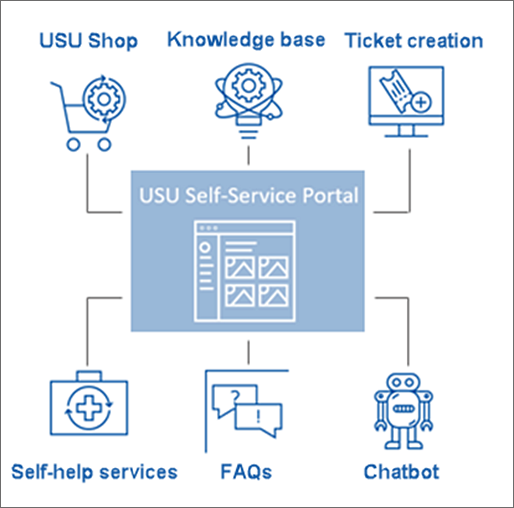
To cover these dimensions, Self-Service Portal comprises several different components:
See also Terms.
This modular approach to the customized self-service means that there are different components available and it is up to customers to decide which suits them the best. The customers can also combine the components in accordance with the requirements into the preferred self-service solution. For example, a customer may require a Portal configuration with the Ticket creation but without the Chatbot as well as any other combinations.
Note
The selection of modules also depends on the objective, user groups and maturity level of the IT organization as well as on the existing tools.
works in conjunction with the other modules and offers a user the central access to the IT services on various end-devices. This modular approach is a key advantage of the USU Self-Service Portal solution.
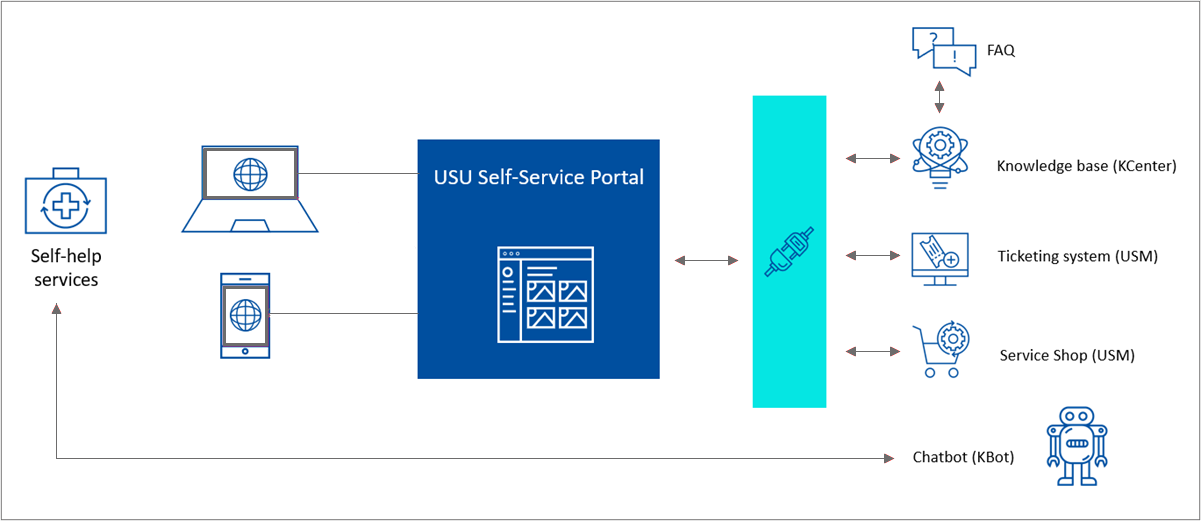
The end user has access via the desktop app or mobile device to the Self-Service Portal.
The Portal in the back end is connected to the source systems with specific adaptors.
Source systems are represented by Knowledge Center (KC) and Chatbot for the knowledge part and chat, USU Service Management (USM) as the ticketing system and USU Shop .
Chatbot itself is connected to self-healing services on a local device.
Alerting (not in the picture) is a kind of isolated component, it is not part of the Portal by default but rather another dimension of the active self-service. For example, to inform a user about the outage so that he will not create a ticket for it.
The quintessential benefit is as follows: Self-Service Portal provides an easy access to all internal company services for your employees and managers.
The other advantages are:
Access to both IT services and non-IT services (HR, Facility, Accounting…).
Displays information from various sources in aggregated and role specific views.
Retrieve information about own services/assets and tasks in process.
Retrieve information about services or assets assigned to my cost centers. It is intended for managers.
Find and retrieve documents, FAQs and guided dialogs from the knowledge database.
Report incidents and get them resolved.
Request new services.
Approve requests. It is intended for managers.
Reduces workload of the IT and other service departments.
Generally increases satisfaction of the end-users.